


-
October 30, 2009
October 22, 2009
my "suburbs" rant

death by suburb: how to keep the suburbs from killing your soul, by dave goetz. harperone, 2007.
i'll start this by cutting to the chase—this book ticks me off. not because i strongly disagree with it, but because i find it to be so devastatingly accurate and ugly. furthermore, it describes a great deal of my own life and character, and that just plain stinks.
i'll start this by cutting to the chase—this book ticks me off. not because i strongly disagree with it, but because i find it to be so devastatingly accurate and ugly. furthermore, it describes a great deal of my own life and character, and that just plain stinks.
dave goetz's death by suburb vividly portrays the world we have fashioned with our american prosperity. to use his term, it is a "thin" world—superficial, insipid, and unsubstantial.
as goetz sees it, the suburbs are...
as goetz sees it, the suburbs are...
- a world where i must be in control
in a world that i will into being, there's not much room for mystery, for the sacred, for that which is outside my control. everything happens for a reason, right? if i want a better marriage, i attend the church's small group on marriage. if i want more knowledge of church history, i take a class at the local christian college. if i want to protect my kids from bad music, i play in the minivan the christian radio station that brands itself, "safe for the whole family." if halloween scares me, my kids and i can attend a fall festival, an alternative halloween event at a large church in our area...i live in a neighborhood so safe that the only way christians "stand up for christ" is by not serving alcohol at the block party. (it's a family neighborhood, after all!) even the construction workers working on the $1 million home next door listen only to nice Christian radio. how nice for our kids!
immersed in a context that values things done right or not at all, i inevitably conclude, most subconsciously, that i can control my life. (25f)
- a world of "competitive parenting"
i absorbed quickly that my children's education needed to be approached like an nba championship. no detail was too small and no standardized test too insignificant. education was not really about learning but about winning. (p.8)
- a world that's all about collecting "immortality symbols"
the meaning of children and their accomplishments is only one suburban immortality symbol. there is the sprawling five-thousand square foot house with the gorgeous sun porch. there is the "ken and barbie" appearance that some couples exude—eternal youth packaged in fresh cleavage and low body fat. for clergy, it's the three-thousand-member mega-church....
there is, frankly, no one more uninteresting than a person with no immortality symbols: the suburban family with no smart or athletic kids that lives in a relatively small house; the poor; the single mom left to raise three kids under twelve after the divorce; the elderly with no winter condo in florida; the midlife pastor with a small congregation. none of these folks is asked to speak at the college alumni banquet. (42f)
- a world that feeds the deadly sins of envy, coveting, and gluttony
the 'burbs are all about striving to be unique, but we all end up competing for the same symbols—the four-bedroom home with the pottery barn colors, the l.l. bean underwear and outerwear, the fuel-guzzling truck, the purebred dog, the family pilgrimage to disney world, and the athletic and scholarship-bedecked college-bound freshman. my wife says she doesn't really covet her neighbor's husband but only the figure of his size 6 wife.... (p.65)
- a world in which "church" is about my consumer preferences
within my protestant family, many churchgoing folk change churches as if they were changing drycleaners. if they come across a coupon for a dime less per laundered shirt, they're off to another store. actually, i think it may be less like shopping and more like casual sex.
it's certainly not about ongoing relationships. it's about the immediate experience, the brief sensation of feeling like i have found a home, a place where i deeply resonate with the worship and theology (at least for a time).
it's one year here and two years there, back to the first church to patch things up, and then on to the cool church with the AUTHENTIC charismatic liturgy where you can find inner healing. few, except for frustrated clergy, admit that local church loyalty is this thin; the reasons offered by church migrants (when someone bothers to ask) always seem reasonable. often the reason goes back to the kids: "there's no youth program for our kids, and we know that over at first church, they have a large youth program. and we really want our kids to make good friends."
parents will lay down their lives if their kids' spirituality and social needs appear to be at stake. it would be better to slap the cub of a she-grizzly than to suggest to any suburban parent that perhaps there are considerations other than the immediate welfare of kids for making decisions.... (127f)
- a world where serving others is primarily about my own significance
i often find myself serving mostly in safe or comfortable programs, where no relationship with someone in deep need forms. there doesn't appear to be any conspiracy to preclude relationships with the poor and broken. it just sort of happens, or, rather, doesn't happen. it's easier not to befriend a single mom who at forty-two with a newborn and only $6-an-hour job skills fears telling the father that he has a son because he might sue for custody because she's in such poverty. why get involved in THAT? there's no upside. (p. 109)
this stuff really hurts. the "american dream" life, the life of prosperity, comfort, safety, efficiency and productivity may be one of the most inhospitable soils in which to grow true disciples of christ that the world has ever known.
moses, who had seen it all, who'd been through slavery and exile and persecution and the wilderness, warned the second generation of israelites who were soon to enter the promised land that they were about to face one of the most severe trials of their lives—the trial of prosperity:
Take care that you do not forget the Lord your God, by failing to keep his commandments, his ordinances, and his statutes, which I am commanding you today. When you have eaten your fill and have built fine houses and live in them, and when your herds and flocks have multiplied, and your silver and gold is multiplied, and all that you have is multiplied, then do not exalt yourself, forgetting the Lord your God, who brought you out of the land of Egypt, out of the house of slavery, who led you through the great and terrible wilderness, an arid waste-land with poisonous snakes and scorpions. He made water flow for you from flint rock, and fed you in the wilderness with manna that your ancestors did not know, to humble you and to test you, and in the end to do you good. Do not say to yourself, ‘My power and the might of my own hand have gained me this wealth.’ But remember the Lord your God, for it is he who gives you power to get wealth, so that he may confirm his covenant that he swore to your ancestors, as he is doing today. If you do forget the Lord your God and follow other gods to serve and worship them, I solemnly warn you today that you shall surely perish. Like the nations that the Lord is destroying before you, so shall you perish, because you would not obey the voice of the Lord your God. (Deut 8.11-20)dave goetz puts it this way:
121314151617181920
i think my suburb, as safe and religiously coated as it is, keeps me from jesus. or at least, my suburb (and the religion of the suburbs) obscures the real jesus. the living patterns of the good life affect me more than i know.i guess what bothers me most is that so few see this. we accept our cultural surroundings like a fish takes water for granted. we don't see anything spiritually harmful in "the patterns of the good life." we don't recognize how they play to the flesh and anesthetize the spirit.
to aid us in battling "the world" as it surrounds us in affluent society, goetz recommends several spiritual practices gleaned from the history of the church and monastery. frankly, i'm not sure they are enough.
- individual transformation through such practices is a key, but only a start.
- at some point we are going to need to talk about what church is all about;
- and living among and walking with the poor;
- and perhaps participating in a movement out of the affluent suburbs and into the cities and needy neighborhoods;
- and forsaking the mindset of "whites only" privilege that continues to predominate in the suburbs so that we can relate and learn with our brothers and sisters from other cultures.
thank you for the wake-up call, dave goetz.

today's van gogh
October 20, 2009
"wild things" i cannot control
david brooks writes an insightful column in today's New York Times about the new film, "where the wild things are." from my perspective, brooks sheds some very helpful light on what it means to be "weak on sanctification."
when describing some insights that the film sheds on the subject of character, brooks contrasts the "philosopher's view" of character with the "psychologist's view."
- the first perspective asserts that individuals have certain ingrained character traits that shape who we are and how we act. i am basically a dishonest person or an honest one. i am either compassionate or unsympathetic. one of the life's great tasks is to develop a deep-rooted character of virtue. then, i can be the "hero" who will always do the right thing and win the day.
- in contrast, the psychologist's view suggests that our actual behavior is not driven by specific permanent character traits that consistently apply across contexts. i may be honest in one situation while dishonest in another. i have many different tendencies that may be activated by various circumstances and moods. i am made up of what Paul Bloom calls, "a community of competing selves."
in the midst of this turmoil, max makes a fantastical journey to an island where wild things live. each of the monsters he meets represents a member of his own "community of selves." brooks comments on what the lad discovers on the island:
the philosophers teach that once we achieve virtue, we do virtuous things. However, the view represented here shows that...in the movie, max wants to control the wild things. the wild things in turn
want to be controlled. they want him to build a utopia for them where they won't
feel pain. but in the movie max fails as king. he lacks the power to control his
wild things. the wild things come to recognize that he isn't really a king, and
maybe there are no such things as kings.
that may be one of the clearest statements of the christian's spiritual struggle that i've read—"there is no easy way to command all the wild things jostling inside." i want to think that if i can only be king and rule over them, all will be at peace and there will be no more sadness. but i am not really a king, indeed, there really are no such thing as kings among ordinary humans. the answer is not within us....people have only vague intuitions about the instincts and impulses that
have been implanted in them by evolution, culture and upbringing [and, I would
specify, our sinful nature]. there is no easy way to command all the wild things jostling inside.
however, there is a king outside of us who has overcome the wild beasts (mark 1.12-13), whom god rescued from the mouths of the menacing monsters and raised up in victory over them (psalm 22.6-24).
each and every moment, i look to this one, king jesus, to tame the wild beasts within.
today's van gogh
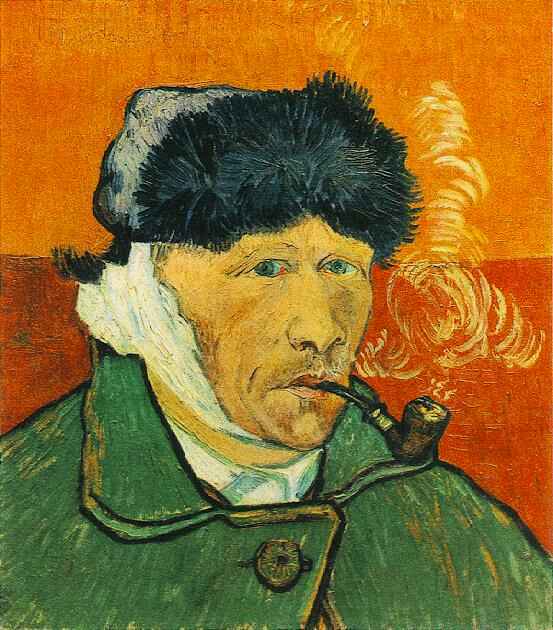
self-portrait with bandaged ear and pipe
October 18, 2009
the weekly discussion—october 18

recently, i listed some of the books that i have been reading lately. for this week's discussion, it would be great to have a conversation about what books have been feeding your mind and spirit.
i'm particularly interested in hearing about books that have given you formative insights in the following areas:
- the spiritual life with christ
- the church: its history, life, and ministry
- loving your neighbor and serving your community
- truths about life, the world, and/or human nature
- important people, events, and/or movements in history
- the relationship between religion and science
"let the wild rumpus begin!"
today's van gogh
green ears of wheat, 1888
October 16, 2009
the lord's day—oct 18, 2009
20th sunday after pentecost
today's lectionary readings
Isaiah 53:4-12
Psalm 91:9-16
Hebrews 5:1-10
Mark 10:35-45
today's bach cantatas
bwv 48, "o wretched man that i am"
bwv 5, "whither shall i flee?"
bvw 56, "gladly shall i bear the cross"
today's van gogh
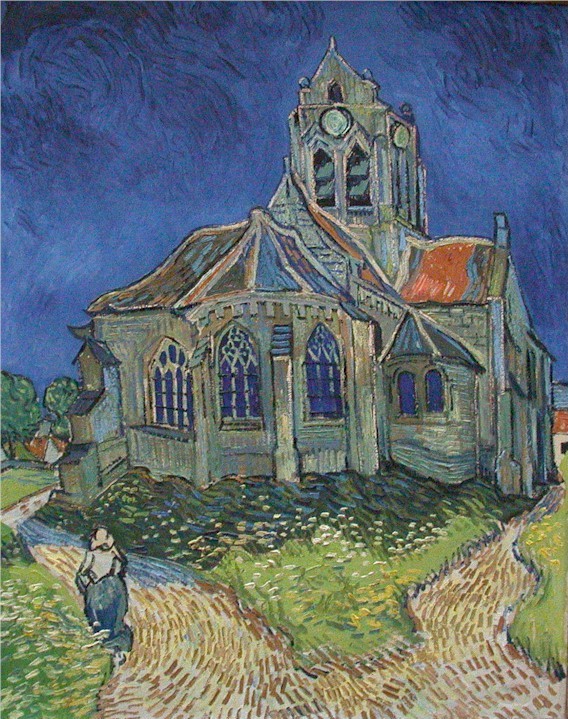
the church at auvers, 1890
today's good news
one of the great leaders of europe over the past quarter century has been václav havel, who emerged at the end of the cold war and became president of czechoslovakia. havel, a writer and playwright, had fought for peace and freedom many years before the Soviet Union fell, suffering constant government harassment and multiple imprisonments because of his writings and work as a political dissident. ironically, this man who had been under the power of a repressive regime, ultimately was voted into a place of power, where during the 1990s he helped lead czechoslovakia into life as a free nation.
upon receiving one of his many awards as a significant force for peace and freedom, havel made a speech about the temptations that come with holding a position of political power. here is part of what he said that day:
power, said václav havel, is pursued by those with high ideals, who want to make a difference in the world. they are also driven by the natural need to be affirmed and feel important. and third, they seek power because it offers attractive and comfortable side-benefits.Why is it that people long for political power, and why, when they have achieved it, are they so reluctant to give it up?
In the first place, people are driven into politics by ideas about a better way to organize society, by faith in certain values or ideals, be they impeccable or dubious, and the irresistible desire to fight for those ideas and turn them into reality.
In the second place, they are probably motivated by the natural longing every human being has for self-affirmation. Is it possible to imagine a more attractive way to affirm your own existence and its importance than that offered by political power? In essence, it gives you a tremendous opportunity to leave your mark, in the broadest sense, on your surroundings, to shape the world around you in your own image, to enjoy the respect that every political office almost automatically bestows upon the one who holds it.
In the third place, many people long for political power and are so reluctant to part with it because of the wide range of perks that are a necessary part of political life -- even under the most democratic of conditions.
in today's gospel lesson, two of jesus' disciples ask if they might be granted positions of power in his coming kingdom. i'm sure they had many good motivations in asking him this.
- first, they were right in understanding what was happening through jesus. god's glorious kingdom was dawning! jesus was the messiah, the promised one who would restore the splendor of david's reign over israel and the world. the long-awaited messianic era of righteousness and peace was about to be revealed, and jesus would be at the center of it all, on the throne.
- second, they wanted to serve and represent him in this kingdom. when something so wonderful is about to take place, who wouldn't want to be an important part of it?
václav havel went on to say this about our motivations in seeking power:
I have never met a politician who could admit to the world, or even to himself, that he was running for office only because he wanted to affirm his own importance, or because he wanted to enjoy the perks that come with political power. On the contrary, we all repeat over and over that we care not about power as such but about certain general values. We say it is only our sense of responsibility to the community that compels us to take upon ourselves the burden of public office. At times, only God Himself knows whether that is true, or simply a more palatable way of justifying to the world and ourselves our longing for power, and our need to affirm, through our power and its reach, that we exist in a truly valid and respectable way.the desire for power may be, for christians, the most misunderstood temptation.
i have watched pastors function as dictators over their congregations, without a clue that their original ideals have become so corrupted that they now brazenly lord it over people. i've seen lay people seize power and hold congregations hostage to their opinions and preferences. i've watched as national evangelical leaders get sucked into the "culture war" mentality and learn to play the game with all the spin and manipulation of the most hard shell, hardball politicians. i've seen brothers and sisters bully one another over the most insignificant issues.
and most of all, i know how much i myself want to be in control, to feel important, to get the cushy assignments, to be seen with the right people, to have others do the grunt work while i enjoy the banquet.
most of the time, we can somehow rationalize what we're doing, claiming it's necessary to achieve a higher purpose. however, i believe that it is the rare person who can successfully navigate the rapids of power.
jesus did, because his modus operandi was sacrifice. from cradle to cross, he laid down his life for us. he came not to be served but to serve. to give his life. to provide a ransom by his own death for those enslaved and imprisoned.
our glory only comes as we die with him. doing so will teach us to treat even the smallest forms of power with extreme caution.
Subscribe to:
Posts (Atom)




 Posts

